 Structural Dynamics Testing in Practice
Volume 2: The Test
The test: instrumentation and data acquisition, the tests you will see, sine, random, shock, mixed-mode, time waveform replication and specialized tests, the control loop, planning, data analysis and data quality, running the test, and writing the report. Volume 1 and Volume 2 together are what it takes for a reader straight out of school to start testing.
Volumes 1 and 2 together: the machine, then the test. Built on Volume 1; a reader who already knows the machine can start here.
- Edition 2026.1
- About 51 hours
- 122 sections
- 16 chapters
- 236 figures
Early access: $895 instead of $1,295 for individual seats, two per lab, until March 31, 2027. Buy Volume 2
Prerequisites
None. No calculus. Theory appears where it changes a decision on the floor, and the equations that do appear are read, not derived.
How the Quiz and the Certificate Work
- Every section ends with an open-book quiz: five questions drawn from that section's pool, four correct to pass.
- Retake as often as you need; only the passing attempt counts, and the next section opens when it does.
- Pass every section and the volume certificate is issued, with a verification page anyone can check and a transcript of every chapter score.
- It is a certificate of completion, not a certification. No CEU or PDH credit is granted; a statement of hours is available.
What Is in Volume 2
16 chapters in reading order. Free chapters and sections are marked; reading minutes are per chapter.
Chapter 1: InstrumentationFree
- 1.1The Measurement Chain Free11 min
- 1.2Sensor Types and What Each Is For Free18 min
- 1.3Reading a Datasheet Free19 min
- 1.4Mounting Free19 min
- 1.5Cables, Conditioning and Grounding Free18 min
- 1.6The Control Accelerometer and Its Backup Free14 min
- 1.7Calibration and Field Checks Free14 min
- 1.8When a Sensor Lies Free15 min
Chapter 2: Data Acquisition
- 2.1What the Acquisition Does to the Signal11 min
- 2.2Sampling and Aliasing33 min
- 2.3Range, Resolution and Overload25 min
- 2.4The Channel Table9 min
- 2.5The End-to-End Check11 min
- 2.6Looking at the Data While It Comes In7 min
- 2.7What to Record and When15 min
- 2.8Data Files as Records8 min
Chapter 3: The Control Loop
- 3.1The Control Loop in Plain Words17 min
- 3.2Random Control: What Happens Between Averages33 min
- 3.3Sine Control: Tracking a Level30 min
- 3.4Shock and Transient Control: Correcting Between Pulses24 min
Chapter 4: Channels, Limits and the Settings That Are the Test
- 4.1Control, Limit and Monitor Channels21 min
- 4.2Alarms, Aborts and What They Cost32 min
- 4.3Before the Run: What the Controller Checks and What It Cannot19 min
- 4.4Equalization, Pretest and Stepping Up19 min
- 4.5Same Profile, Different Test10 min
Chapter 5: The Tests You Will See
- 5.1Environment Families on One Page16 min
- 5.2Functional, Endurance and the Other Test Names13 min
- 5.3What a Profile Has Been Through17 min
- 5.4Margin and Duration19 min
- 5.5The Standard Categories as Vocabulary10 min
- 5.6Reading a Requirement and Its Provenance Block11 min
- 5.7What a Shaker Does Not Do8 min
- 5.8The Map of This Volume3 min
Chapter 6: Sine Vibration
- 6.1What the Article Does With a Tone27 min
- 6.2What a Sine Test Represents11 min
- 6.3Reading and Writing a Sine Profile18 min
- 6.4Sweeps: Linear, Log, Rate, Direction and Time21 min
- 6.5The Resonance Search as a Measurement24 min
- 6.6Dwells and Tracked Dwells as Fatigue Tests11 min
- 6.7Low-Frequency Sine for Spacecraft and the Sine Burst11 min
- 6.8Tolerances and What a Pass Means9 min
- 6.9Protecting the Article: Limits, Notches and Aborts8 min
- 6.10Watching a Sine Test and What Goes Wrong14 min
Chapter 7: Random Vibration
- 7.1What a Random Test Represents9 min
- 7.2Reading the Profile20 min
- 7.3Same grms, Different Test9 min
- 7.4Peaks, the Gaussian Assumption, Clipping and Kurtosis20 min
- 7.5Tolerances and What "In Tolerance" Means25 min
- 7.6Notching, Limiting and Force Limiting15 min
- 7.7The Campaign: Survey, Signature, Steps, Duration, Axes16 min
- 7.8Where Random Profiles Come From9 min
- 7.9What Goes Wrong10 min
Chapter 8: Shock
- 8.1What a Shock Test Represents14 min
- 8.2Classical Pulses: Shape, Velocity Change and Tolerance21 min
- 8.3Will It Fit on the Shaker28 min
- 8.4Compensation as the Standards See It13 min
- 8.5The Shock Response Spectrum21 min
- 8.6SRS Tests: Synthesis, Duration and Tolerance15 min
- 8.7Pyroshock and the Other Machines9 min
- 8.8Watching a Shock Test and What Goes Wrong14 min
Chapter 9: Mixed-Mode Tests
- 9.1What Mixed Mode Is10 min
- 9.2Reading a Sine-on-Random Profile19 min
- 9.3Reading a Random-on-Random Profile9 min
- 9.4How the Controller Builds and Measures a Composite22 min
- 9.5The Data Sheet: Floor, Tones and Total13 min
- 9.6Headroom, Stroke and Aborts14 min
- 9.7Legacy Forms and What Goes Wrong7 min
Chapter 10: Time Waveform Replication
- 10.1When the Measured Event Is the Test12 min
- 10.2The Reference and Its Edit Log15 min
- 10.3Scaling and Margin11 min
- 10.4Can This Shaker Play It27 min
- 10.5The Iteration16 min
- 10.6Judging the Replication25 min
- 10.7Applications: Road Load, Weapon-Bay Transients, Gunfire and Seismic18 min
- 10.8What Goes Wrong, and Multi-Exciter Replication10 min
Chapter 11: Specialized Tests
- 11.1Transient Sine: Beat and Multi-Sine13 min
- 11.2Vibration at Temperature13 min
- 11.3Transport and Packaging15 min
- 11.4Screening10 min
- 11.5Acoustic, and Where the Shaker Stops8 min
- 11.6The Other Machines9 min
Chapter 12: Planning the Test
- 12.1Three Documents, Four Parties, One Gatekeeper16 min
- 12.2The Decisions Before Scheduling11 min
- 12.3The Article: Identity, Configuration, Adjustments, Handling10 min
- 12.4Channels, Predictions, Limits and Aborts on Paper12 min
- 12.5Pass, Fail, Completion and Interruption Recovery13 min
- 12.6The Schedule by Axis10 min
- 12.7Risk and the Safety Case12 min
- 12.8The Readiness Review and the Pre-Job Brief8 min
- 12.9The Skeleton and the Test That Is Not Ready16 min
Chapter 13: Data Analysis and Data Quality
- 13.1Look at the Time History First21 min
- 13.2From Samples to Autospectrum33 min
- 13.3Resolution, Window and Averaging16 min
- 13.4Sine and Transient Data20 min
- 13.5FRF, Transmissibility and Coherence15 min
- 13.6Cross-Channel Sanity Checks10 min
- 13.7Wrong While the Controller Says Pass12 min
- 13.8Comparing Runs and Surveys12 min
- 13.9The Record and the Reviewer12 min
Chapter 14: Running the Test
- 14.1The Room14 min
- 14.2The Pre-Test Checklist25 min
- 14.3The Article on the Table11 min
- 14.4Low-Level Runs16 min
- 14.5Stepping Up11 min
- 14.6Aborts and Interruptions by Cause17 min
- 14.7The Log and the As-Run Procedure11 min
- 14.8After the Last Run19 min
Chapter 15: Writing the Report
- 15.1Who Reads It and What Each Checks8 min
- 15.2The Flash Report8 min
- 15.3The Skeleton18 min
- 15.4Results Against the Requirement14 min
- 15.5Plots That Answer Questions10 min
- 15.6Deviations, Anomalies and Nonconformances14 min
- 15.7The As-Run Record and the Data Package9 min
- 15.8Review, Sign, Release and Amend8 min
Chapter 16: One Test, Start to Finish
- 16.1The Test, the Plan and the Data Package15 min
- 16.2Before Full Level11 min
- 16.3The Five-Minute Look on Every Channel13 min
- 16.4The ASD, Its Degrees of Freedom and Its Band9 min
- 16.5Against the Specification13 min
- 16.6Transmissibility and the Signature15 min
- 16.7Writing It Up19 min
Also included, open to every seat from the first day: Glossary and Units.
Self-Paced Online or a Dedicated Week
For a whole lab: a week at your site, built around your systems and the tests you run, with seats on Volumes 1 and 2 for everything else.
| Row | Self-Paced Online | Dedicated Week |
|---|---|---|
| Format | Read online, one section at a time, with the figures live in the page and a quiz at the end of each section. | Five days at your lab, on your own system. The online course is the pre-work, so the week goes to review and hands-on time instead of lecture. |
| Time | About 51 hours at your own pace, within 12 months of first sign-in. | Five days on site, after the pre-work. A minimum completion is set per block and shown on the team page; the default is half of the volume's sections passed before day 1. |
| Who It Suits | One person, or a team of any size buying seats. | A whole lab. Cap of 12 people, with hands-on groups of 6. More than 12 means a second week. |
| What It Includes | Every section, figure and Decide box, the lab kit print pages, the quiz, the question box, the transcript and the certificate. | A seat for every attendee, review targeted by the quiz results, hands-on work on your system, Q and A on your machine, and the in-person certificate. |
| Price Basis | Per seat, from the published price table. Team tiers from 4 seats. | Always quoted. Quotes are valid 30 days. Domestic travel is included in the week. Every week is priced for its site: the days on site, the preparation for your equipment and procedures, and a seat on Volumes 1 and 2 for every attendee. |
| Certificate | The volume certificate of completion, with a public verification page, and a transcript with every chapter score. | The volume certificate, earned online, plus the in-person certificate recording the dates, the lab and the hands-on work on your system. |
Seats for a Lab
A new engineer or technician needs both halves before they are trusted at the console: the machine, and the test. Volumes 1 and 2 give them that in the order the work meets them, with a quiz on every section and a transcript for your training file. The dedicated week at your lab puts the hands on.
- Tiers in one line: $1,295 each for 1 to 3 seats, a lab pack of 4 for $4,780, $1,095 each from 5, $995 each from 10, and 9 seats includes the tenth.
- Hand out seat codes, or invite each person by name and email. One named person per seat.
- The team page shows progress and quiz scores per seat, never answers.
- Exports in CSV, spreadsheet and PDF for ISO/IEC 17025 and AS9100 training files.
- Renewal $295 per seat keeps your people on the current edition; corrections and new editions are free while a seat is active.
- Invoice against a purchase order from $5,000, net 30. Below that, card only.
About This Volume
How Long Does a Seat Last?
A seat covers one volume for 12 months from the first sign-in. Renewal after that is $295 per user a year, and the renewal window stays open for 90 days after the seat expires.
What Does a Seat Cost?
A single seat is $1,295. Five or more seats are $1,095 each and ten or more are $995 each. A 4-seat lab pack is $4,780. Quotes are available on request for any order.
Can I Pay by Invoice?
Orders from $5,000 can be paid against a purchase order. A quote is valid for 30 days.
What Is the Refund Policy?
A seat can be refunded within 14 days of purchase if less than 20 percent of the volume has been completed. Unactivated team seats can be refunded within 30 days.
Can a Seat Be Reassigned?
A team manager can move a seat to another person within the year if the first holder has completed less than 25 percent of the volume.
What You Receive at the End
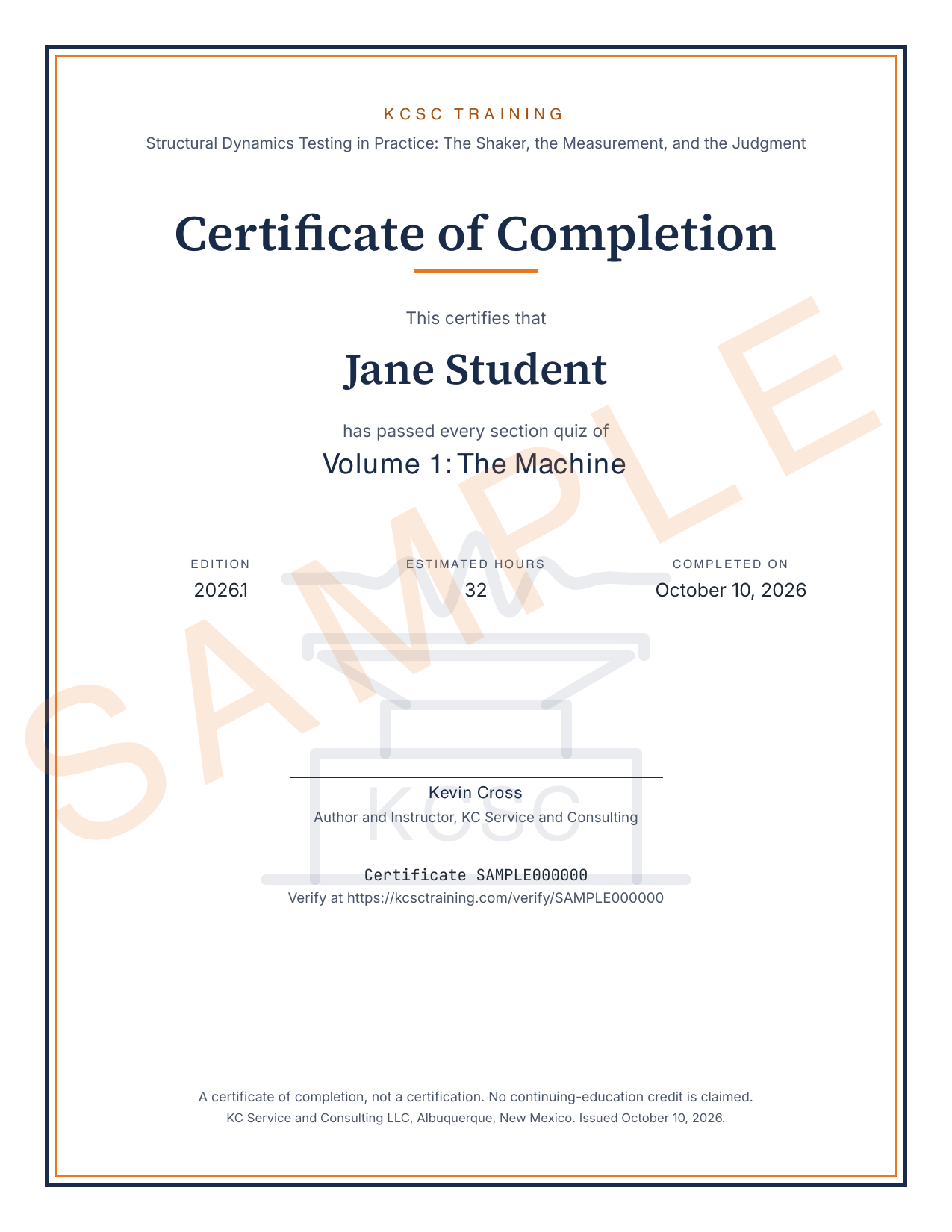
A sample. The real certificate carries the holder's name, the edition, the hours, the average quiz score and a verification code.
Two Volumes to Start Testing
Volume 1 is the machine, Volume 2 is the test; together they give someone new to the lab what it takes to start testing, under supervision the first time. Volume 3, multi-axis testing, is for the advanced user. A seat on one volume buys the other at $1,095 for 90 days after it opens.

Volume 1 Available now
The Machine
The machine: the shaker system, the facility, and keeping both running. Volume 1 and Volume 2 together are what it takes for a reader straight out of school to start testing.
10 chapters, 68 sections, about 34 hours
Volume 2 Available now
The Test
The test: instrumentation and data acquisition, the tests you will see, sine, random, shock, mixed-mode, time waveform replication and specialized tests, the control loop, planning, data analysis and data quality, running the test, and writing the report. Volume 1 and Volume 2 together are what it takes for a reader straight out of school to start testing.
16 chapters, 122 sections, about 51 hours

Volume 3 Coming soon
Multi-Axis Testing in Practice
Multi-axis and MIMO testing as a practice, for the reader who already runs tests and is moving to multi-axis work.
7 chapters planned. Slated for 2027.