Power and cable an IEPE or charge sensor for the run length and frequency
Keep ground loops and cable noise out
An IEPE Sensor Drives Its Own Cable
Every swing charges the cable's capacitance from the constant current
Too fast for the current: the peaks slewed, the reading low at high frequency and high level
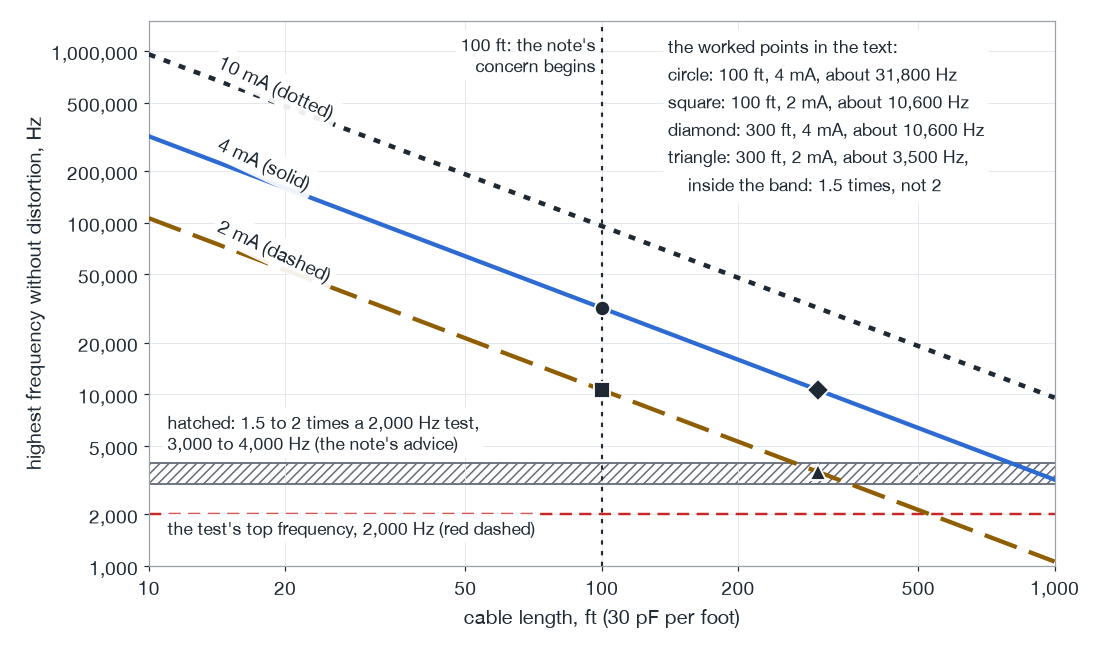
One note: set the current so the limit is 1.5 to 2 times the top of the band
Runs beyond about 100 ft (30 m) a concern for high-frequency, shock and transient work
The Cable Limit, Worked
30 pF per foot, 5 V peak: 100 ft at 4 mA, about 31,800 Hz; at 2 mA, about 10,600 Hz
300 ft at 2 mA: about 3,500 Hz, short of twice a 2,000 Hz test; 4 mA brings back 10,600
Worst at the peak: clean at the low level, distorted at full level
From the long-cable relation in the text: 30 pF per foot, 5 V peak output. Dotted 10 mA, solid 4 mA, dashed 2 mA. The worked points are the text's arithmetic.
Figure 1.6. The highest frequency an IEPE channel carries without distortion, against cable length, for constant currents of 2, 4 and 10 mA at a peak output of 5 V on a cable of 30 pF per foot, from the relation above. The band from 1.5 to 2 times a 2,000 Hz test is shaded, and the 100 ft mark where the note's concern begins is drawn.
The Low End: the Shortest Time Constant Governs
A piezoelectric chain is a high-pass, with a corner set by its time constant
Sensor, conditioner coupling and controller input each have one; the shortest governs
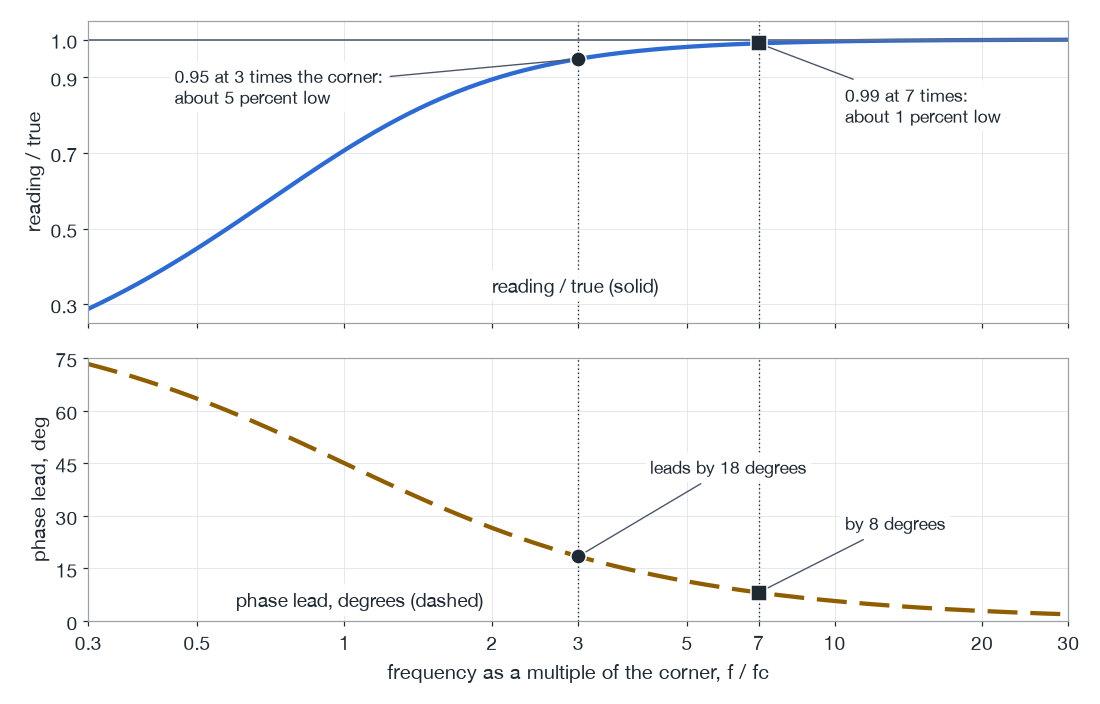
About 5 percent low at three times the corner, about 1 percent low at seven times
A Long-Stroke Sine Starting at 5 Hz
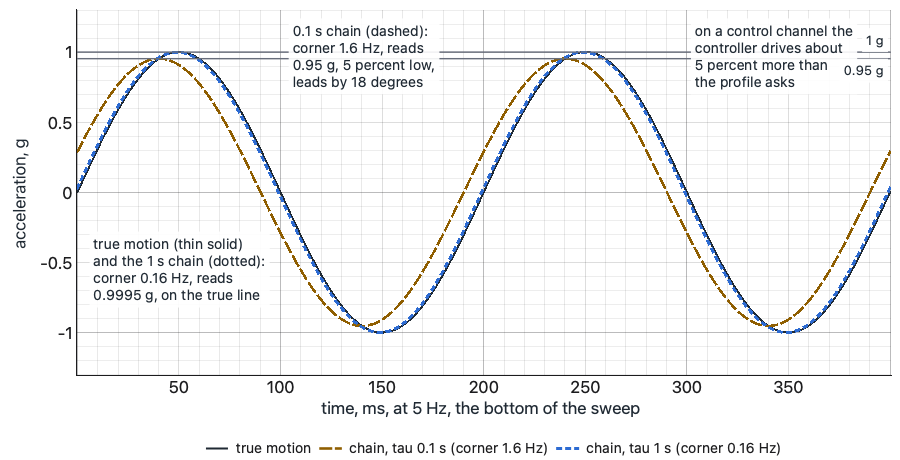
Shortest time constant 0.1 s: corner 1.6 Hz, the channel about 5 percent low at 5 Hz
The controller drives 5 percent more, at the bottom of the sweep where the stroke is tightest
One second: corner 0.16 Hz, and the error gone
a. A single high-pass
Reading over the truth (solid) and phase lead (dashed) against frequency as a multiple of the corner; circle at 3 times, square at 7 times.
b. Two chains at the bottom of a 5 Hz sweep
A true 1 g peak sine at 5 Hz and what two chains report: shortest time constant 0.1 s (corner 1.6 Hz) and 1 s (corner 0.16 Hz).
Synthetic, normalized to 1 g peak; steady state. The chain's shortest time constant governs.
Figure 1.7. A single high-pass filter's reading and phase lead against frequency as a multiple of its corner, with the 5 percent point near three times the corner and the 1 percent point near seven times marked. Two chains are drawn against a long-stroke sine starting at 5 Hz, one with a corner of 1.6 Hz and one with a corner of 0.16 Hz, with the error each makes at the bottom of the sweep.
The Two-Number Problem
With an external conditioner, the scaling is split: its gain, and the sensitivity the controller is told
Either one wrong mis-scales the channel, and the controller cannot tell which
Decide where the sensitivity lives and put it there once
Cable Noise and Cable Care
Charge systems: a flexing cable makes its own charge, spikes and wander that follow its motion
Every cable strain-relieved at the sensor, clamped along the fixture, never run to the shaker's hood
Connectors in a chamber sealed; instrument cables apart from amplifier cables, crossing at right angles
The Ground Loop
The sensor case, the fixture, the armature, the shaker body, grounded at the amplifier
The conditioner grounded at its own outlet; the cable shield joins the two
Signature: a comb at the line frequency and its harmonics, there with the drive at zero
One Deliberate Ground
The loop broken at one chosen place, and left that way
At the sensor: an isolated stud, an insulating disc, an insulated base, or polyimide tape
At the rack: inputs that do not tie the shield to the rack's ground
The protective earth is never lifted to cure hum
The Hum That Was Not the Article's
A comb at the line frequency on the chassis channels, with the drive at zero
It stayed with the article off, and came and went with the amplifier
Insulating discs under the sensors, and the comb was gone
Decide
One deliberate ground; a loop broken at the sensor or an isolated input; the protective earth never lifted
Every IEPE run's length and current checked against the top of the band at full-level peak output
Every chain's low-frequency limit worked out from its shortest time constant
Every cable tied down and strain-relieved; every sensitivity entered once for the whole chain and read back
This page is part of the KCSC Training course and is licensed to one named reader for viewing. It does not print. Lab kit pages print from the Lab Kit menu.